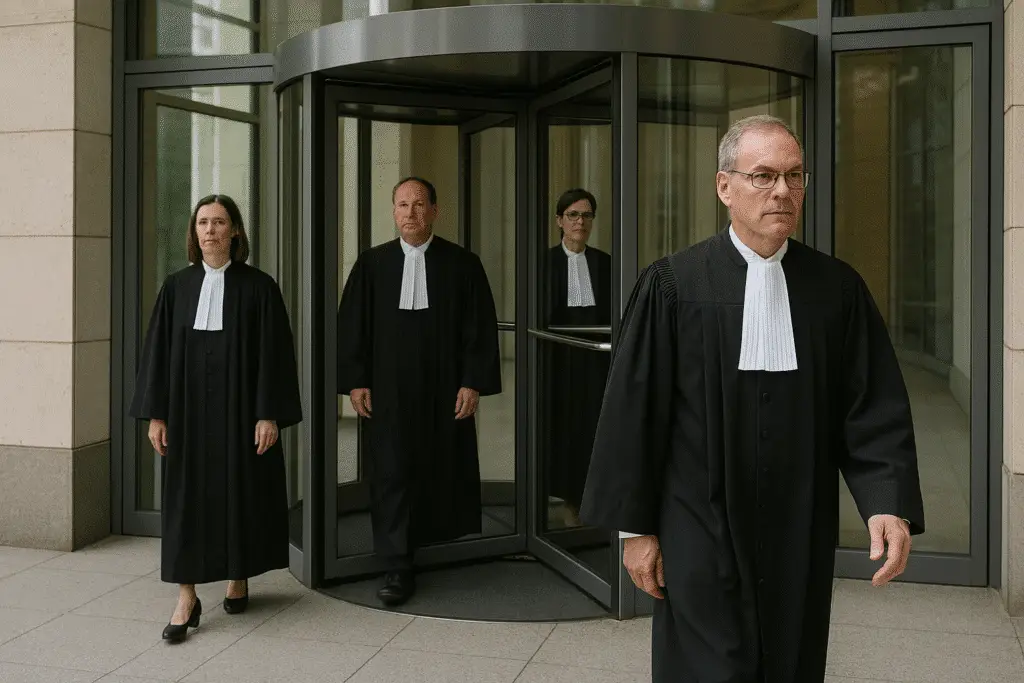
Challenging a judge in the Netherlands is called wraking: you ask for a judge to be replaced because of facts or circumstances that could harm judicial impartiality, and a separate multi-judge chamber of the same court decides. The main limitation: you must file as soon as you learn of those facts, and there is no appeal against the decision.
The rules are in Articles 36 to 41 of the Dutch Code of Civil Procedure (Rv), Articles 512 to 518 of the Code of Criminal Procedure (Sv) and Articles 8:15 to 8:20 of the General Administrative Law Act (Awb). The rules in all three codes were amended with effect from 1 January 2026; this article reflects the current text.
What is a challenge, and what is it not?
A challenge asks one question: can this judge still be seen as impartial in this case? It is based on the right to an independent and impartial tribunal under Article 6 of the European Convention on Human Rights (ECHR).
The statutory ground is the same in all three codes: any judge hearing a case can be challenged on the basis of facts or circumstances that could harm judicial impartiality (Article 36 Rv, Article 512 Sv, Article 8:15 Awb). This covers a single judge, every member of a full bench, an examining magistrate and appeal judges.
The mirror instrument is recusal (verschoning): the judge asks to withdraw on the same grounds (Article 40 Rv). Courts check parties and lawyers in advance, so most impartiality issues are resolved this way before anyone raises them.
A challenge is not a remedy against procedural rulings. A refused adjournment or a rejected witness is not a ground in itself; the remedy is an appeal in the main case. Complaints about a judge’s conduct go through the court’s complaints procedure, which does not lead to replacement. A challenge cannot be directed at the public prosecutor, opposing counsel or court staff.
裁判官の職務執行に異議を申し立てることができるのはどのような場合か?
A judge is presumed impartial unless exceptional circumstances show otherwise. Courts apply a subjective test (does the judge actually hold a personal bias?) and an objective test (is there an objectively justified fear of partiality?).
Your own feeling of unease is not enough. Successful challenges usually involve one of these situations:
- A personal, family or business relationship between the judge and a party, witness or lawyer.
- A financial or professional interest of the judge in the outcome.
- Earlier involvement in the same dispute as lawyer, adviser or decision-maker.
- Remarks at the hearing showing the judge has already decided a point still open.
- Side activities, listed in the public register of ancillary positions, directly linked to the subject of the case.
Earlier judicial involvement needs care. A judge who decided an earlier case between the same parties, or gave an interim ruling in this case, is not partial for that reason alone. It becomes a ground only if the earlier decision contained a firm view on exactly the point still to be decided.
How and when do you file a challenge?
File as soon as the facts become known to you (Article 37(1) Rv). If you wait to see how the hearing develops, the request will fail.
The request must be written and reasoned; after the hearing has started it can also be made orally (Article 37(2) Rv). All facts and circumstances must be put forward at once (Article 37(3) Rv). A second request against the same judge is only considered if it rests on facts you learned after the first one (Article 37(4) Rv).
A challenge is possible only while the case is pending. Once the final decision has been given, your route is an appeal against that decision. The criminal and administrative rules work the same way (Article 513 Sv, Article 8:16 Awb).
What happens to your case in the meantime?
The case is suspended immediately (Article 37(5) Rv). The challenged judge stops dealing with the case, including taking decisions, unless something cannot wait.
In criminal and administrative cases, a request made at the hearing suspends the hearing (Article 513(5) Sv, Article 8:16(5) Awb). The delay is the main strategic factor. In fast proceedings such as preliminary relief or detention hearings, a weak challenge costs more than it can achieve.
How does the challenge chamber decide?
A multi-judge chamber in which the challenged judge does not sit hears the request as soon as possible (Article 39(1) Rv). The applicant and the challenged judge are given the opportunity to be heard, if necessary separately (Article 39(2) Rv).
The challenged judge can first agree to step aside (berusten) under Article 38 Rv. The judge is then replaced without any finding on whether the challenge was justified, and the case continues. Otherwise the judge usually gives a written response explaining the remark or relationship in question.
A manifestly inadmissible or manifestly unfounded request can be decided without a hearing (Article 39(3) Rv). The chamber gives a reasoned decision, announced in public (Article 39(4) Rv). The hearing deals only with impartiality, not with the merits of your case. Decisions of challenge chambers are often published on rechtspraak.nl.
In case of abuse, the chamber can decide that a further challenge in the same case will not be dealt with, and states this in its decision (Article 39(5) Rv). That power exists because each challenge suspends the case and repeated requests could otherwise bring it to a standstill.
What does the decision mean for your case?
If the challenge is upheld, another judge takes over. A hearing that had already started is usually held again, because a judge may only decide on what that judge has heard.
If the challenge is rejected, the same judge continues where the case was suspended. The judge is not required to withdraw, and the challenge may not be held against you. The time lost depends on how quickly the chamber can schedule the request.
Can you appeal against the decision?
No. Since 1 January 2026, Article 39(6) Rv states that no remedy is available against the decision; Article 515(6) Sv and Article 8:18(6) Awb say the same for criminal and administrative cases.
The Supreme Court (Hoge Raad) also ended the old exception for so-called breaking grounds (doorbrekingsgronden) on 21 June 2024 (ECLI:NL:HR:2024:918). That ruling still referred to Article 39(5) Rv, the numbering before 2026. The bar now covers every appeal, even one alleging that the challenge rules were wrongly applied.
The point is not lost. You can raise impartiality in an appeal or cassation against the final judgment in the main case, arguing that the case was not heard by an impartial tribunal under Article 6 ECHR. If new facts emerge, you can file a new challenge.
申請前に確認すべきことは何ですか?
A challenge stands or falls on concrete, verifiable facts. Check:
- Exactly what was said or what relationship exists, and from which source you know it.
- When you first learned of it, because you must file immediately (Article 37(1) Rv).
- Whether the objection is really about a ruling, for which the remedy is an appeal.
- Whether you have gathered all grounds, since all must be raised at once (Article 37(3) Rv).
- Whether the delay of suspension is worth it, given that a rejected request leaves you before the same judge.
- Whether a factual question to the court, for example about a registered side activity, can resolve the issue first.
Keep the request factual and narrow. The chamber assesses circumstances, not tone, and a measured request is more persuasive and less likely to be treated as abuse. For wider context, see our indexes of オランダ民法ガイド (NAIST) と オランダの刑法ガイド.
What can we do for you with a challenge of a judge?
現場の声を力強いメッセージへ。 民事弁護士 advise parties in civil, criminal and administrative proceedings on impartiality issues:
- We assess whether your facts amount to a recognised ground for a challenge.
- We advise on whether an appeal in the main case is the better route.
- We draft a written, reasoned challenge request and file it without delay.
- We represent you at the hearing before the challenge chamber.
- We raise impartiality in an appeal against the final judgment where appropriate.
製品概要
- Any judge can be challenged on facts or circumstances that could harm impartiality (Article 36 Rv, Article 512 Sv, Article 8:15 Awb).
- File as soon as you learn of the facts, and raise all grounds at once (Article 37 Rv).
- The case is suspended until a separate multi-judge chamber decides.
- No remedy is available against the decision (Article 39(6) Rv), not even on breaking grounds (ECLI:NL:HR:2024:918).
- Impartiality can still be raised in an appeal against the final judgment.
よくある質問
Who decides on a request to challenge a judge?
A multi-judge chamber of the same court, in which the challenged judge does not sit (Article 39(1) Rv). The applicant and the judge can be heard.
Can I challenge a judge because I disagree with a ruling?
No. Disagreement with a procedural or substantive ruling is not a ground for a challenge. The remedy is an appeal in the main case.
Is there a deadline for challenging a judge?
Yes. You must file as soon as the facts become known to you (Article 37(1) Rv). Waiting to see how the hearing goes will cause the request to fail.
Can I appeal against the decision on my challenge?
No. No remedy is available (Article 39(6) Rv), and since ECLI:NL:HR:2024:918 not even on breaking grounds. You can raise impartiality in an appeal against the final judgment.